
Many people begin drinking Japanese tea through feeling before language. They know that one tea feels softer, another brighter, another deeper or more calming, yet they do not always have the words to explain why. This is completely natural. Tea is often understood first through impression, and only later through vocabulary.
That vocabulary, however, can change everything.
Once you begin to recognize the essential attributes of a tea, the experience becomes clearer without becoming colder. You do not lose the pleasure of intuition; you simply gain a more precise way of noticing it. A tea no longer seems merely “good” or “not for me.” It begins to reveal whether what draws you is its sweetness, its fragrance, its texture, its restrained bitterness, or the quiet depth of its umami.
This matters especially in Japanese tea, where nuance often carries more meaning than force. Many of the most beautiful teas do not announce themselves through intensity alone. They move through balance, proportion, and the way several attributes interact at once. A Sencha may feel fresh because its astringency is held in check by sweetness. A Gyokuro may feel deep not only because of umami, but because of the texture that carries it. A Hojicha may feel comforting through fragrance as much as through taste.
This guide is meant to make that world more legible by offering a clearer way to understand what you are already perceiving. The more easily you can recognize these six essential attributes (bitterness, astringency, sweetness, umami, fragrance, and texture), the more naturally Japanese tea begins to open.
Tea attributes matter because they give shape to perception. Without them, tasting can remain vague, limited to broad impressions that are difficult to compare or remember. With them, even a beginner can start to understand why two teas of the same type may feel entirely different, or why a tea that seemed difficult at first becomes beautiful once it is approached with more clarity.
This is particularly important in Japanese tea, where difference often appears in fine gradations rather than in dramatic contrast. The distance between one Sencha and another is not always a matter of category, but of balance: a little more sweetness here, a little more astringency there, a different texture, a quieter fragrance, a fuller umami. To notice these things is not to overcomplicate the tea. It is simply to begin seeing what is already there.
Tea attributes also help the drinker move beyond judgment into understanding. A tea does not need to be described only as smooth, strong, pleasant, or difficult. Those words may be true, but they do not explain much. If a tea feels challenging, is it because of bitterness, or because of dryness on the palate? If it feels rich, is that coming from umami, from fragrance, or from texture? Once these distinctions become visible, preference becomes more precise. You no longer have to ask only, “Do I like this tea?” but can begin asking, “What part of this tea is speaking to me?”
That shift is valuable because it creates a more lasting relationship with tea. It becomes easier to choose what to explore next, easier to read tasting notes with confidence, and easier to understand why certain teas belong to certain moments of the day or certain moods. A drinker who knows they are drawn to sweetness and low astringency will naturally move differently through the world of Japanese tea than someone who seeks brightness, tension, and lift.
In this sense, tea attributes are not merely descriptive tools. They are a way of learning how to pay attention. They remind us that tea is not only something to consume, but something to read; slowly, carefully, and with enough sensitivity to notice that what first seems simple is often made of many quiet parts working together.

Bitterness is often the first attribute beginners learn to notice in tea, but it is also one of the easiest to misunderstand. In everyday language, bitterness is usually treated as a flaw—as something that should be removed, softened, or avoided. In Japanese tea, however, bitterness is more subtle than that. It can certainly become excessive when the tea is poorly balanced or aggressively brewed, but in the right proportion, it is often part of what gives a tea structure, energy, and definition.
To understand bitterness properly, it helps to separate it from harshness. A tea can be slightly bitter without feeling unpleasant. In fact, a small degree of bitterness can sharpen the outline of a cup, making sweetness feel clearer and freshness feel more vivid. Without it, some teas would feel flat or overly soft. The question is rarely whether bitterness exists at all. The real question is whether it is integrated well enough to support the tea rather than dominate it.
In Japanese green tea, bitterness is often linked to compounds such as catechins, and this is one reason brewing matters so much. Water that is too hot, or an infusion that goes on too long, can pull bitterness forward until it overwhelms the more delicate aspects of the leaf. What might otherwise have felt balanced can quickly become severe. This is especially relevant for teas like Sencha, where brightness and freshness are part of the style, but where those same qualities can tip into unpleasant sharpness if the tea is pushed too hard.
At the same time, bitterness is not distributed evenly across all Japanese teas. Some cultivars and some processing styles naturally lean toward softer, sweeter, or more rounded expressions. Shaded teas, for instance, are often prized precisely because their balance tends to move away from bitterness and toward umami and sweetness. Roasted teas such as Hojicha also step into a different aromatic world, where bitterness is usually less central to the experience. This is why bitterness should never be treated as the essence of Japanese tea as a whole. It is one attribute among several, and its role changes from tea to tea.
What makes bitterness so important to understand is that it often teaches proportion. A tea with no bitterness at all can sometimes feel pleasant but indistinct. A tea with too much bitterness can feel hard and tiring. Between those two extremes lies a range where bitterness becomes useful—where it gives lift, length, and contrast. When that balance is right, bitterness does not feel like resistance. It feels like part of the tea’s architecture.
For the drinker, learning to recognize bitterness is less about deciding whether it is good or bad than about noticing how it behaves. Does it arrive immediately and disappear quickly, or does it linger and dry the palate? Does it brighten the cup, or flatten it? Is it softened by sweetness, supported by umami, or pushed too far by the brewing? These are the questions that turn bitterness from a vague impression into a meaningful part of tasting.
And once that happens, bitterness becomes easier to appreciate for what it really is: not a defect, but a force that, when held in balance, helps tea feel alive.

Astringency is one of the most important tea attributes to understand because it is so often confused with bitterness. The two can appear together, and for beginners they are easy to merge into a single impression of “sharpness.” But they are not the same thing. Bitterness is a taste. Astringency is a sensation.
It is felt less on the tongue than on the surfaces of the mouth. Astringency creates dryness, grip, or a slight tightening on the palate. It can make the mouth feel as though moisture has been gently drawn away. This is why a tea may taste only mildly bitter and yet still feel firm, brisk, or drying. Once this distinction becomes clear, tasting Japanese tea becomes much more precise.
Like bitterness, astringency is not automatically a flaw. In the right amount, it gives Sencha and other green teas their tension and clarity. It can lift the cup, create contrast, and prevent sweetness or umami from becoming too soft or diffuse. A tea with no astringency at all may feel smooth, but it can also feel unfocused. A tea with too much astringency, by contrast, can feel tiring, rigid, or hollowing. The goal is balance, not absence.
Astringency also changes the way a tea moves through the mouth. Some teas feel smooth at first, then leave a faint dryness that sharpens the finish. Others begin with brightness and grip, then soften as sweetness emerges afterward. This is one reason astringency matters so much in evaluating structure. It helps define the outline of a tea, the same way acidity can do in wine or tannin can do in other beverages. It gives shape to the experience.
In Japanese tea, astringency is closely tied to brewing. Water temperature, infusion time, leaf quantity, and the physical condition of the leaf all influence how strongly it appears. A tea that feels elegant and refreshing under one set of conditions can become hard and drying under another. This is especially true in teas where freshness and briskness are part of their identity. Astringency, then, is not only a property of the leaf. It is also part of the interaction between leaf, water, and technique.
It is also useful to notice how astringency differs from tea to tea. In some Sencha, it appears as brightness and energy. In deep-steamed teas, it may be softened by body and suspended more gently in the liquor. In shaded teas, it often recedes to make space for sweetness and umami. In roasted teas, it may become far less central to the experience. Learning to notice these shifts is part of learning how Japanese tea builds character through proportion rather than force.
For the drinker, the key question is not simply whether a tea is astringent, but what kind of astringency it has. Is it fine and refreshing, or coarse and drying? Does it support the tea’s freshness, or does it flatten the finish? Does it disappear quickly, or does it remain on the palate longer than the tea’s sweetness and fragrance? Once these questions enter the tasting process, astringency stops being a vague discomfort and becomes one of the clearest ways to understand a tea’s structure.
And that is why it matters so much. Astringency teaches the difference between flavor and form. It reminds us that a tea is not judged only by what it tastes like, but also by how it feels as it passes through the mouth and what kind of shape it leaves behind.

Sweetness in Japanese tea is rarely the kind that announces itself immediately. It is not sugary in the obvious sense, nor is it usually the first attribute beginners name when they take a sip. More often, it appears quietly, through softness, roundness, and the way a tea leaves the palate gentler than it found it. It may arrive in the middle of the sip, or only become clear in the finish, after brighter or more structured qualities have begun to recede.
This is one reason sweetness can be so easy to miss at first. Many drinkers expect sweetness to behave in tea the way it behaves in food, as something direct and easily recognizable. But in Japanese tea, sweetness is often relational. It is felt more clearly because it is held against freshness, balanced by astringency, or deepened by umami. A tea does not need to taste overtly sweet to possess sweetness. Sometimes it is enough that the cup feels rounded rather than sharp, or that the finish leaves behind a gentle, almost soothing impression.
In this sense, sweetness often plays a stabilizing role. It softens bitterness without erasing it. It gives freshness a place to land. It makes a tea feel more complete, more composed, and more hospitable. This is part of why sweetness matters so much in Japanese tea: it is not simply a pleasant extra, but one of the attributes that helps the whole structure feel coherent.
Brewing has a strong influence here as well. A tea that is brewed too forcefully may lose much of its sweetness beneath bitterness or dryness. A gentler infusion, by contrast, often gives sweetness more room to emerge and remain visible. This is one reason Japanese tea can feel so rewarding to revisit with slightly different brewing choices: what seemed absent in one cup may become obvious in the next once the balance shifts.
For the drinker, sweetness is best understood not as an isolated note, but as a sign of harmony. It often tells you that the tea is holding itself together well, that its sharper elements are supported rather than exposed. When sweetness appears clearly in Japanese tea, it rarely feels decorative. It feels structural. It is one of the attributes that allows a tea to feel generous.
And perhaps that is why sweetness can become so memorable, even when it is quiet. It leaves behind a sense not only of flavor, but of ease. A tea that carries sweetness well often feels like a tea you want to return to; not because it is trying to charm you, but because it has found a natural balance that makes returning feel effortless.
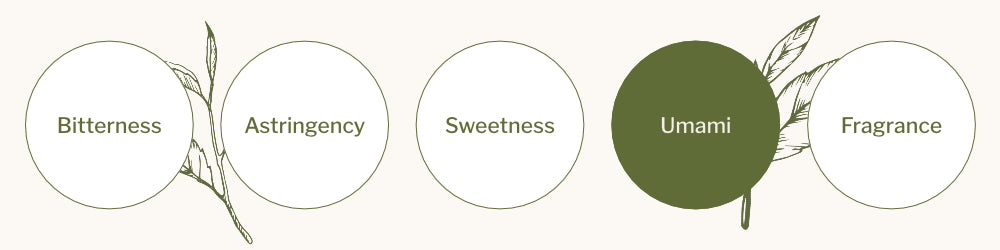
Umami is one of the most important words in Japanese tea, and one of the most misunderstood. Beginners often hear it described so frequently that it starts to feel abstract, almost ceremonial—as if it names a special quality one is expected to notice without ever being told clearly what it is. In reality, umami is not mysterious, but it does require a different kind of attention than bitterness or fragrance. It is less immediate, less easy to isolate, and often easier to feel than to describe.
The simplest way to understand umami is to stop thinking of it as sweetness, even though the two are often related. Umami is not sugary, floral, or dessert-like. It is a deeper kind of savoriness—a sensation of fullness, depth, and lingering substance. In tea, it often appears as a rounded, almost broth-like richness that gives the cup gravity without heaviness. When present in balance, umami can make a tea feel expansive, calm, and deeply satisfying.
This is why umami is so central to Japanese tea. Many of the teas most prized in Japan are not admired for intensity alone, but for the way they carry this quiet depth. A tea with umami does not usually strike through force. It gathers itself slowly on the palate, often widening the middle of the sip and extending the finish. It can make the tea feel softer and more enveloping, even when the liquor itself is light in body.
Part of what makes umami difficult for beginners is that it rarely appears alone. It often travels with sweetness, and it can be easily obscured by bitterness, astringency, or brewing that is too aggressive. A tea brewed too hot may still contain umami, but the sharper attributes can rise in front of it and make it harder to perceive. This is one reason certain Japanese teas reveal their depth more clearly under gentler brewing conditions: umami often needs space to emerge.
Shaded teas are especially important here. In teas such as Gyokuro, Kabusecha, and the leaves used for Matcha, umami often becomes much more visible because shading encourages a different balance within the leaf. But umami is not limited to those teas alone. It can also appear in Sencha, particularly in teas made from tender leaves or cultivars known for softness and depth. What changes is not only the amount of umami, but the way it is carried. In one tea it may feel subtle and integrated; in another, it may become one of the defining features of the cup.
It also helps to understand that umami is not merely a flavor note, but part of a tea’s overall structure. It affects how long the tea lingers, how complete it feels, and how much depth can be sensed beneath the more visible surface attributes. A tea may smell fresh, taste vegetal, and show a little sweetness, but it is often umami that gives it inner weight. Without that depth, some teas feel pleasant but fleeting. With it, they feel settled and memorable.
For the drinker, learning to recognize umami often means paying attention to what happens after the first impression. Does the tea seem to widen in the mouth rather than narrow? Does it leave behind a savory, mouth-filling persistence rather than only a clean finish? Does it create a sense of depth that feels nourishing rather than merely aromatic? These are often better questions than trying to force a single tasting word too soon.
That is why umami is worth learning patiently. It teaches the palate to look beyond brightness and beyond immediate flavor, toward the quieter dimensions that make Japanese tea so distinctive. Once it becomes recognizable, many other teas begin to make more sense. What seemed vague at first starts to feel foundational. And with that shift, tea becomes not only easier to describe, but deeper to experience.
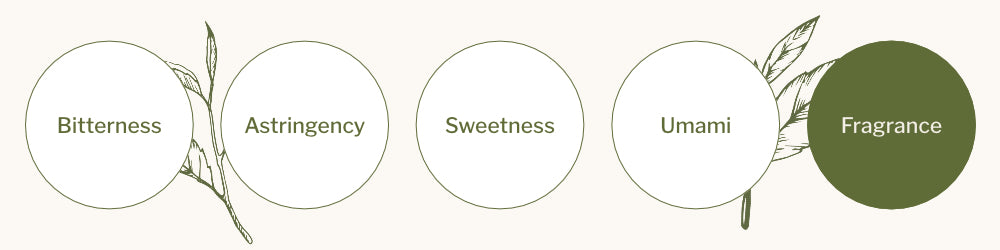
Fragrance is often the first thing a tea gives us, and one of the hardest things to describe well. It arrives before taste, before texture, and often before clear judgment. A cup may seem fresh, warm, elegant, deep, or comforting even before it reaches the lips, simply because its fragrance has already begun shaping expectation. For this reason, fragrance in Japanese tea is never a secondary detail. It is part of the tea’s identity from the very beginning.
What makes fragrance difficult is that it does not stay still. It changes with temperature, with water, with the state of the leaf, and with the stage of the experience; is is a sequence. There is the aroma of the dry leaf, which can already suggest much about the tea’s direction. There is the fragrance released as water first meets the leaves, often more immediate and volatile. Then there is the aroma that rises from the liquor itself, followed by what remains after swallowing.
In Japanese tea, this sequence matters greatly because aroma often carries the tea’s emotional tone.
A Sencha may open with something green, bright, and almost spring-like, giving the cup a sense of lift before any bitterness or sweetness is perceived. A Wakoucha may release softer, deeper notes from the very first breath, suggesting warmth, fruit, or quiet sweetness before the palate has fully caught up. A shaded tea may feel calmer and more inward in its fragrance, already hinting at the umami and depth to come. In each case, fragrance does more than decorate the tea. It prepares the way the tea will be received.
Fragrance is also one of the clearest places where processing becomes visible. Steaming, roasting, shading, and finishing all leave their mark not only on flavor, but on aromatic character. This is why two teas that may seem close in structure can still feel completely different once lifted to the nose. Fragrance is one of the languages through which processing and cultivar begin to speak.
It is useful, too, to understand that fragrance is not always about intensity. A tea with a loud aroma is not necessarily more refined than one with a quieter one. Some of the most beautiful fragrances in Japanese tea are subtle and require closeness rather than distance. They do not rush outward; they gather gently. This is especially important for beginners, who may assume that stronger aroma means higher quality. In tea, clarity and harmony often matter more than force.
Fragrance also shapes memory in a particular way. Taste can be fleeting and difficult to isolate, but aroma often stays with the drinker long after the cup is gone. A tea may be remembered as grassy, toasted, floral, marine, warm, or deeply green not only because of what it tasted like, but because of what it suggested through fragrance. This is one reason aroma can be such a powerful part of tea appreciation: it links perception with mood more immediately than almost any other attribute.
For the drinker, the most useful question is not simply “What does this tea smell like?” but “What kind of atmosphere does its fragrance create?” Does it feel fresh or warm, direct or quiet, high and lifted or deep and settled? Does the aroma change once the tea is in the cup? Does it remain in the mouth after swallowing, or disappear quickly? These questions help fragrance become more than a list of tasting notes. They turn it into a way of understanding the tea’s character as a whole.
That is why fragrance deserves to be noticed with care. It is often the first threshold into a tea, and sometimes the most revealing. Before flavor has fully formed and before texture has had time to settle, fragrance is already telling the drinker how to enter the cup.
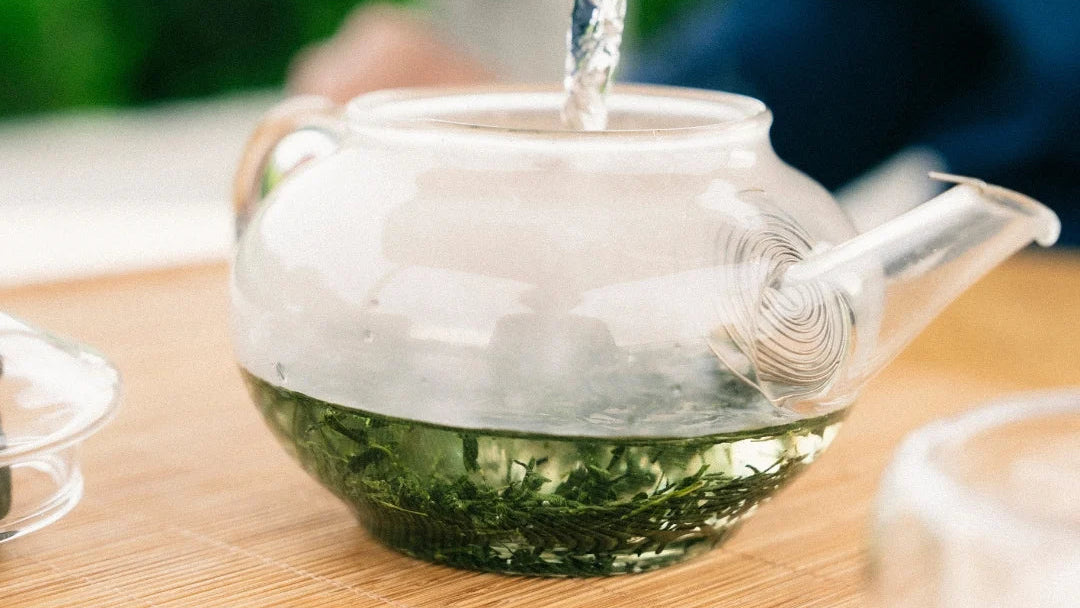
Texture is one of the most overlooked tea attributes, perhaps because it is harder to name than taste or fragrance. A drinker can usually say when a tea smells floral, roasted, green, or sweet. Texture is different; it's about how it moves, how it settles on the tongue, how it spreads through the mouth, how dense or light it feels, and what kind of physical presence it leaves behind.
Multiple teas may share similar aromatic or flavor notes and still feel completely different because of the way they are carried in the liquor. One may seem light, transparent, and almost delicate, while another feels broader, softer, or more enveloping. In one tea, the sip passes quickly and cleanly. In another, it lingers with a quiet weight that makes the whole cup feel deeper than its flavor notes alone would suggest.
Texture is often where many other attributes begin to make more sense. Sweetness, for example, is often made more visible by a tea’s softness on the palate. Umami can feel more profound when it is supported by a fuller body. Even astringency changes character depending on texture: in a thinner tea it may feel more pointed, while in a tea with more body it may seem integrated and restrained. This is part of what makes texture so important. It does not exist beside the other attributes. It helps determine how they are perceived.
In Japanese tea, texture can vary greatly depending on the style of tea, the cultivar, the processing, and the brewing.
A lightly steamed Sencha may feel clearer and more linear, while a deep-steamed Sencha often carries more density and softness in the cup. A shaded tea may feel more rounded and sustained because of the body that carries it. Matcha, of course, brings texture into the foreground entirely, since the leaf itself is consumed rather than infused. Even among teas of the same type, changes in infusion time, water temperature, and leaf quantity can shift the texture quite noticeably.
This is one reason texture can be so rewarding to pay attention to. It often reveals quality in a quieter way than fragrance or taste. A tea may not be the most immediately aromatic, and it may not have the strongest sweetness or umami, yet if it moves through the mouth with coherence and ease, it can still feel deeply refined. Texture often tells you whether the tea is holding itself together well.
For the drinker, the best questions are often physical rather than descriptive. Does the tea feel thin, silky, rounded, creamy, firm, or expansive? Does it pass quickly across the palate, or does it gather and remain? Does the body of the liquor support the tea’s flavor, or does it leave the tea feeling scattered? These are the kinds of questions that make texture easier to notice, even when it is difficult to name precisely.
In that sense, texture teaches a different kind of attention. It asks the drinker to notice not only what the tea says, but how it arrives. Once that awareness develops, the experience of tea becomes fuller. Flavor and fragrance remain essential, but they no longer stand alone. They are carried by a body, a movement, and a tactile presence that often determine whether a tea feels merely interesting or genuinely complete.
No tea is defined by a single attribute alone.
This is one of the most important things to understand when learning how to taste Japanese tea. A tea may be praised for its umami, known for its fragrance, or remembered for its sweetness, but none of these qualities exist in isolation. What gives a tea its identity is the way several attributes meet, balance, and support one another in the same cup.
This is why two teas can share one visible quality and still feel entirely different.
A tea may be sweet, but if its texture is thin, that sweetness may feel fleeting. Another may be equally sweet, yet because it is carried by more body and supported by fragrance, it feels deeper and more complete. A tea may show a little bitterness, but if that bitterness is held in balance by softness and length, it can feel energizing rather than severe. In the same way, umami without freshness can become heavy, and fragrance without structure can feel beautiful at first but leave little behind. What matters, then, is how it is integrated.
Japanese tea often expresses itself through proportion. One attribute rises, another holds it in place, another extends it, another softens it. This is part of what makes tasting so rewarding. A tea does not need to be intense to be memorable. Very often, the most refined teas are the ones in which nothing feels isolated or excessive, and where each quality gives shape to the others.
This is also why tea tasting becomes more interesting as soon as the drinker stops asking only, “What do I notice?” and begins asking, “How is this tea put together?” That question shifts the experience from description to understanding. Sweetness, bitterness, astringency, umami, fragrance, and texture stop behaving like separate categories and begin to feel like parts of a single structure.
In that sense, the goal of tasting is not to reduce tea to analysis. It is to see more clearly what gives a cup its coherence. Some teas are built around contrast, where brightness and softness sharpen one another. Others are built around harmony, where fragrance, umami, and texture gather into something calm and continuous. Neither is inherently better. What matters is whether the tea feels alive in its own proportion.
Once that becomes visible, tasting changes. Tea is no longer judged only by strength, rarity, or immediate appeal. It is understood through balance, movement, and the relationship between its quiet parts. And that is often where Japanese tea becomes most beautiful.
Learning to notice tea attributes does not mean turning tea into a technical exercise. If anything, it does the opposite. It makes tea easier to enter, easier to understand, and easier to remember. What once felt vague begins to take shape. A cup is no longer simply “good” or “interesting,” but bright, soft, fragrant, drying, rounded, or quietly deep in a way that can be felt and named.
That shift matters because it brings you closer to the tea itself. The more clearly these attributes become visible, the more naturally preference begins to form. You start to understand what you enjoy and why. You begin to recognize whether you are drawn to freshness or warmth, to sweetness or structure, to fragrance that rises quickly or texture that lingers more slowly. And from there, choosing tea becomes less uncertain and far more personal.
This is especially meaningful in Japanese tea, where so much beauty lives in nuance. The most memorable cup is not always the strongest, the sweetest, or the most aromatic. Very often, it is the one whose attributes are held in the most convincing balance, and whose character reveals itself with enough clarity that you can follow it from beginning to end.
In that sense, learning these six attributes is a way of paying better attention to tea. And once that attention begins to deepen, every cup has more to offer.
The 6 Tea Attributes: A Comprehensive Guide
Sencha: Japan's Most Popular Green Tea